

By: Meng Seavmey
BANTEAY MEANCHEY and ODDAR MEANCHEY PROVINCES — It gets very hot during the day and quite cold at night. Displaced and affected by the weather, students at safe centers are fighting for both their education and well-being.
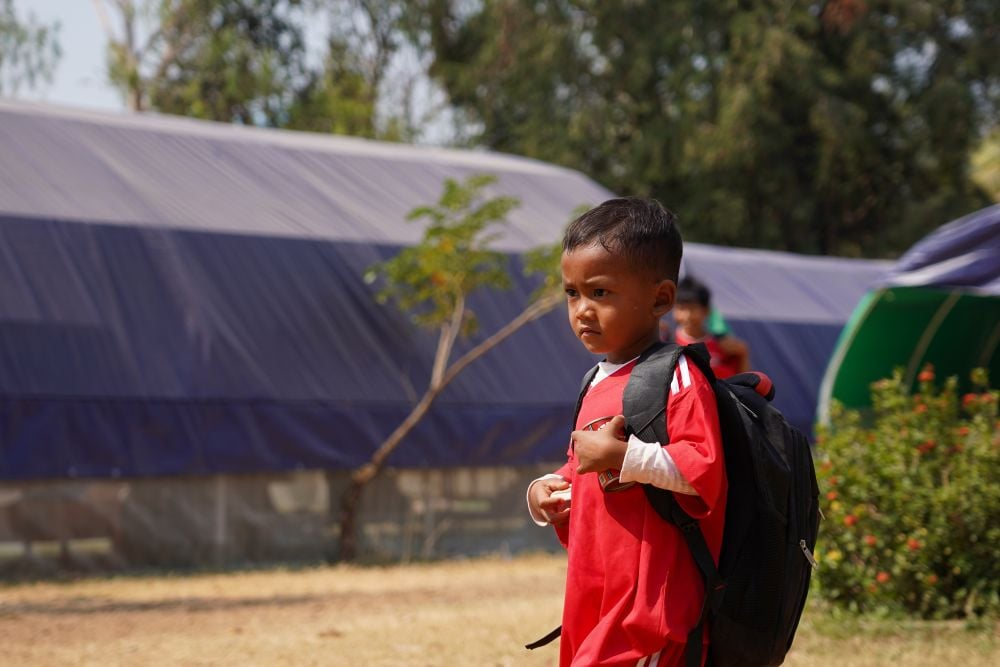
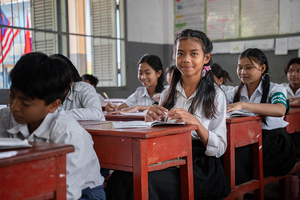
This photo shows a boy leaving his class in the afternoon at Kandol Primary School. Photo: Soy Rathanakvisal
Humanitarian aid and government support have helped bring back people’s hope for survival and their livelihood—both during the weeks of clashes and after the ceasefire in the Cambodia-Thai border conflict. Help, however, cannot be provided evenly as relocation sites near towns are more acessible than those at more distant locations.
This is also the reality of the difference between children studying at the temporary schools in Chong Kal Safe Center and Wat Bat Thkav Safe Center in Oddar Meanchey province and those at Kandol Primary School in Banteay Meanchey province.
Still, all these schools were reopened because all felt—the authorities, teachers, parents and also the students—that this was essential. Bombs might be dropped but education must go on, they said. So in class, the pens must be held up, tightly, rightly and purposely while the ceasefire is being upheld.
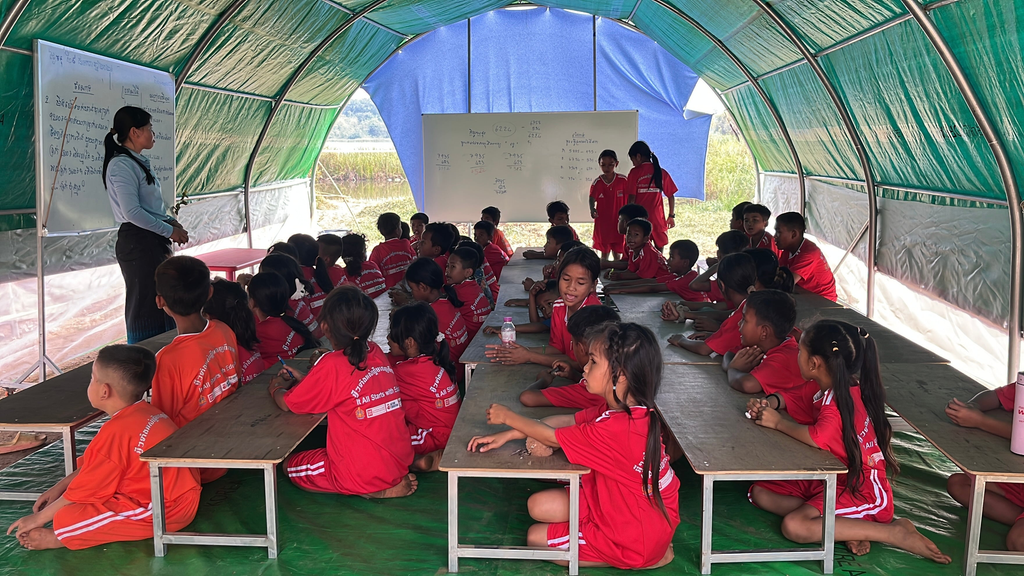
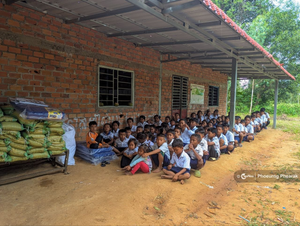
Caption: Students resume their studies at the Wat Bat Thkav Safe Center in Oddar Meanchey province. Photo: Meng Seavmey
However, for the students at the Wat Bat Thkav Safe Center, it was not school periods as usual. They had to move from one location to the next during a class in search of shade, looking for trees near the pond that served as a cooling system in the day’s heat.
“There were not even tables: everywhere that offered shade would be called a classroom,” said Phlong Koy, director of the Department of Education, Youth and Sport in Samraong district, who is also staying at the Wat Bat Thkav Safe Center as a displaced person.
The schedule depended on the sunlight, he said. Studying hours were based on the duration of the shade available. All the teachers were displaced people.
The situation at the school has since improved and, while a few teachers have left to return home, some have remained as their homes are in the red zones, that is, the areas where people cannot return due to severe damages caused during the conflict and the explosive ordanances on the ground that need to be removed.
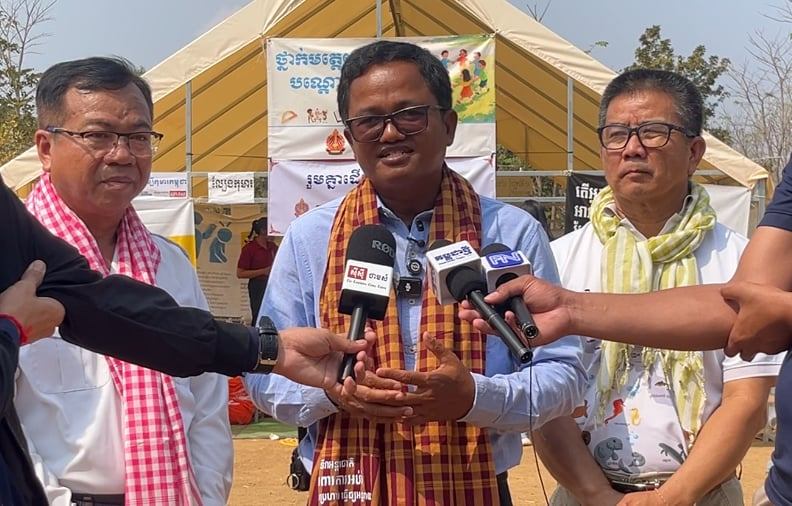
Phlong Koy (C), director of the Department of Education, Youth and Sport in Samraong district, is one of the people staying at the Wat Bat Thkav Safe Center as a displaced individual. Photo: Meng Seavmey
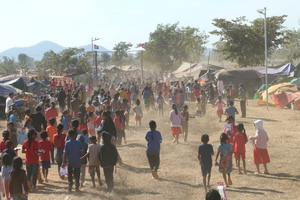
At the Chong Kal Safe Center, all the displaced families are from Banteay Ampil district in Oddar Meanchey province, an area in the red zone in the border conflict, said Oeurn Keam, director of the Department of Education, Youth and Sport for the district.
The center was established on Dec. 8, 2025, following the renewed border clashes of Dec. 7. As of Jan. 19, there were 4,442 families—approximately 10,000 people—staying at the displacement site.
At first, the students were studying in only six classes at the temporary school that was built in cooperation with partners and donors. Later on, the Ministry of Education, Youth and Sport and Aide et Action Cambodia—an association whose goal is development through education—built more classes, resulting in 29 classes and a library.
Today, the Chong Kal Safe Center teaches classes of both primary and secodary levels while the Wat Bak Thkav Safe Center focuses on primary school programs.
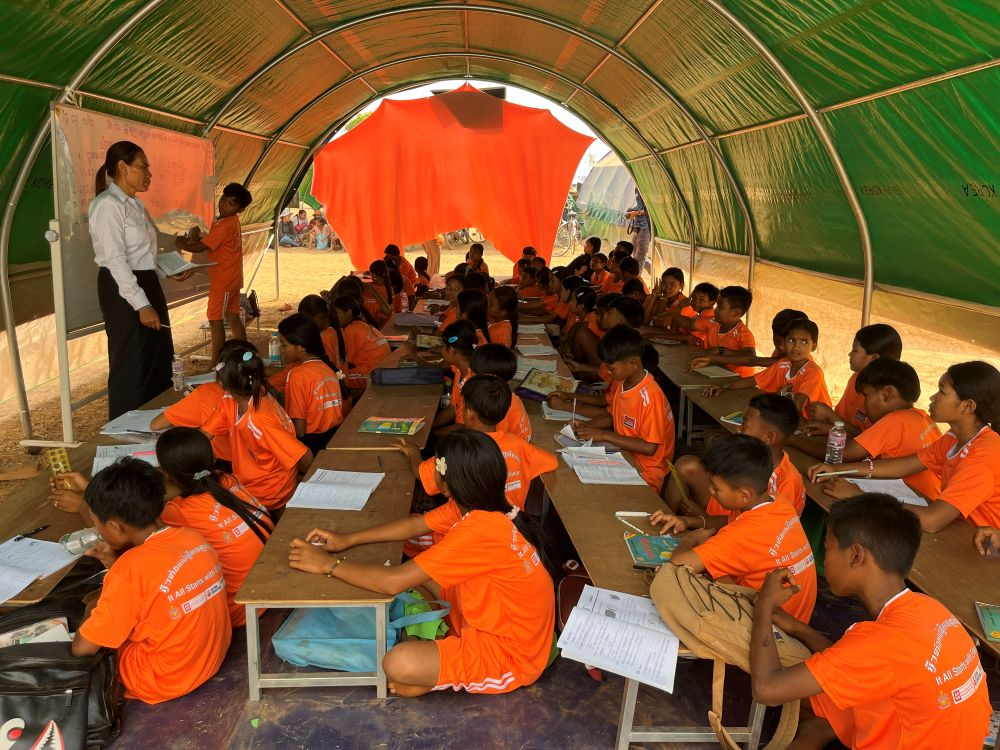
Students continue their learning at the temporary school of the Chong Kal Safe Center in the afternoon. Photo: Meng Seavmey
“None of the students were left behind, without education,” Keam said. “After the clashes broke out, the teachers also came to the displacement site to continue their teaching, enabling students to continue their studies.”
A difficulty that the Chong Kal Safe Center has faced is the lack of access to water. Still, students have remained in class, committed to studying even when the temperature gets over 33 degrees Celsius in the afternoon.
In the evening, there have been students coming to study to take advantage of the temperature going down. This has added to the teachers’ duties as they have to look after the nightshift learners, and yet the teachers have agreed to do so.
As part of the teaching staff, Keam has depended on donations, provisions and facilitation from all stakeholders including the Ministry of Education, organization partners and donors, in order to hold classes for students while also helping the teachers deal with the situation.
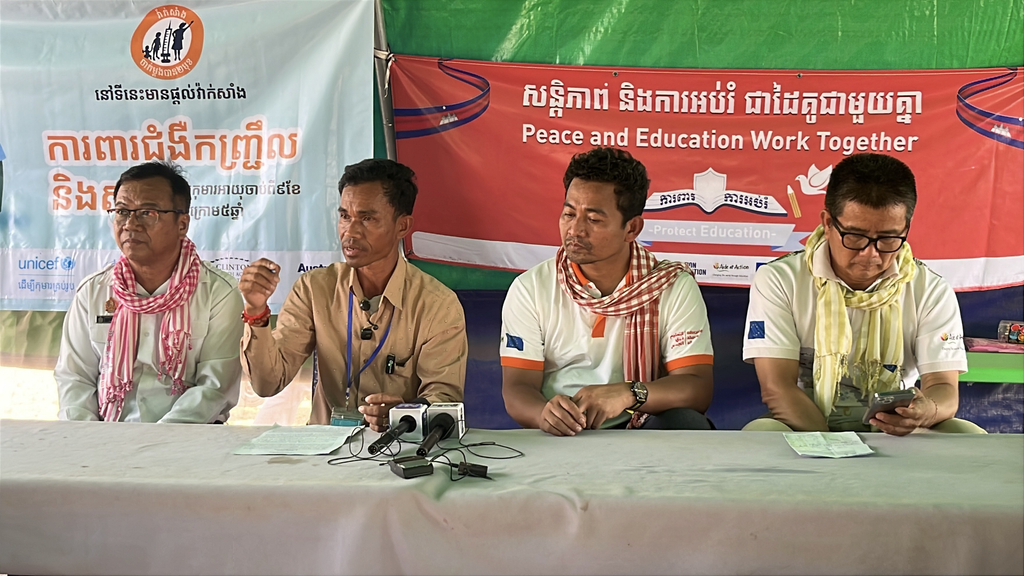
Oeurn Keam (2nd L), director of the Department of Education, Youth and Sport in Banteay Ampil District, is also a displaced person due to the conflict. Photo: Meng Seavmey
For students of the Banteay Meanrith Primary School, the change of facility has not been as drastic. As of Jan. 20, a total of 552 students were temporarily attending Kandol Primary School.
Their old school may no longer stand. As Neum Chheang, principal of the Banteay Meanrith Primary School, explained, one building of six classes has reportedly been demolished during the strikes in the Thai-Cambodia border conflict. Chheang has not been able to obtain more information due to the barbed wires laid by the Thai forces blocking access to the school grounds, he said.
“The evacuation wasn’t planned,” Chheang said. “People ran away without taking anything with them, except a few clothes. The teachers had no material for teaching.
“However, teaching and studying are now going well with the help of the authorities, tents being provided for temporary classes along with documents and studying materials,” he said.
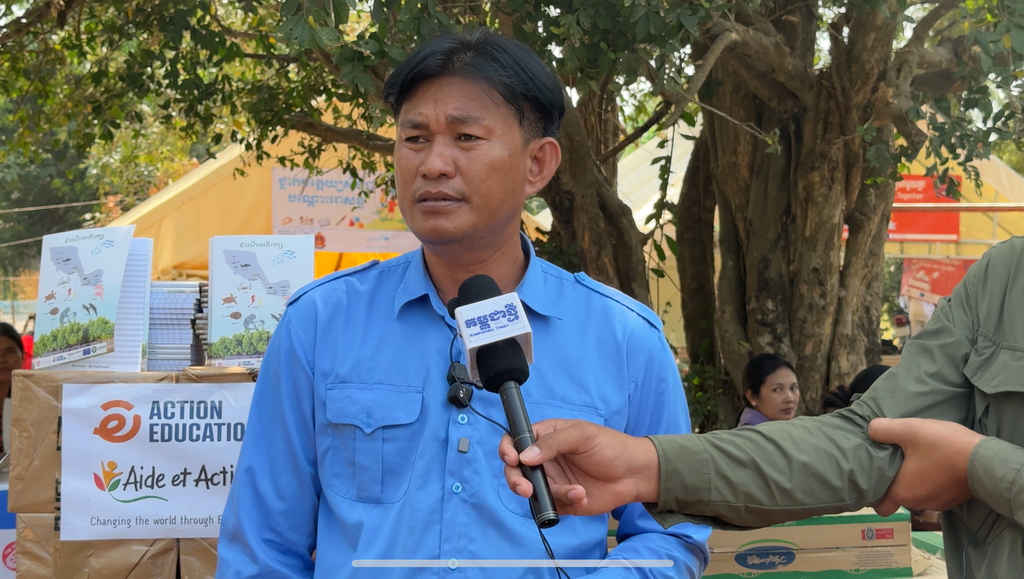
Neum Chheang, principal of the Banteay Meanrith Primary School, is one of the displaced people from the Boeung Trakuon area in Oddar Meanchey province. Photo: Top Sovannara]
Since Jan. 5, school activities have been proceeding well, supported by contributions and donations from the public, organizations and the Cambodian authorities.
The temporary school offers primary-level education with Khmer literature and mathathematics as the subjects. Although the program is limited, Chheang said, “I’m glad that the students are able to continue their studies.” As for the fact that these students may not be able to return to their old school, he pointed out that teaching and studying can be done anywhere, whether in a school or in the shade of a tree.
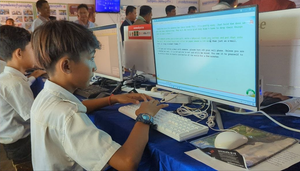
More fortunate than at some of other schools, the students staying at this safe center have had access to a bigger variety of educational contents thanks to the digital learning system set up on the provided computers.
This has been an opportuny for the teachers to expand their abilities and for students to develop digital skills. However, the temporary school still lacks study material and clothes for students and teachers.
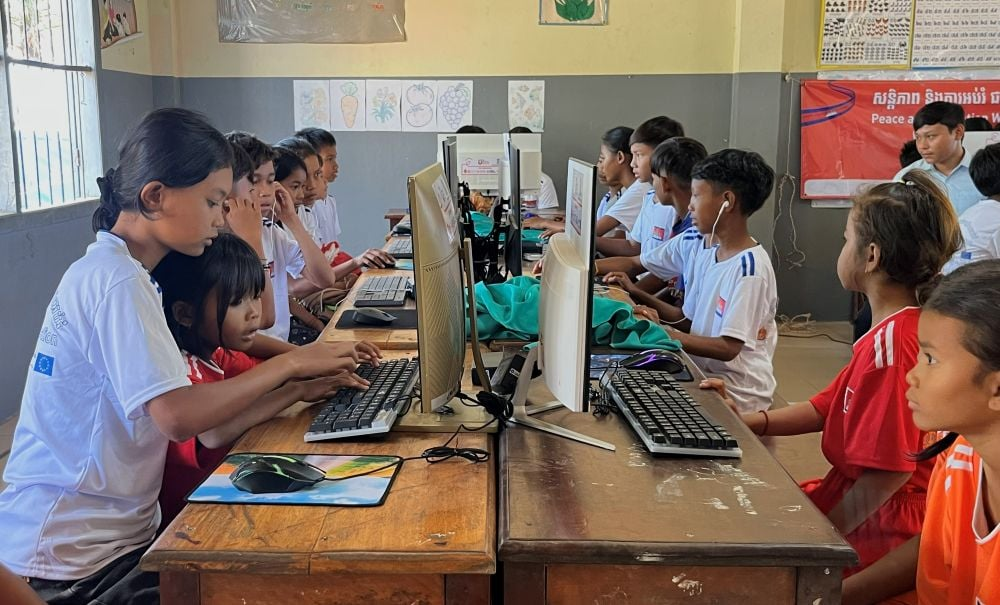
Students of Banteay Meanrith Primary School have had the opportunity to use the Ministry of Education’s digital learning system. Photo: Meng Seavmey
Continued Support Is A Must
Since the start of the conflict, Aide et Action/Action Education, in partnership with the Education Above All Foundation’s Educate A Child programme, has been working with the local officials of the Ministry of Education at each safe center—the NGO that has been working in cooperation with the ministry and several NGOs since 2002 to help improve children’s access to primary education in the country.
As Vorn Samphors, the NGO’s country director, explained during an interview at the Wat Bak Thkav Safe Center, the NGO has built 30 physical classes, set up tents for 30 temporary classes, helped 300 schools reopen and receive displaced students, and helped install computers for digital learning in 100 schools.
“We will be working with the ministry to continue construct more buildings to reopen classes for the students and also build temporary schools at displacement sites,” he said.
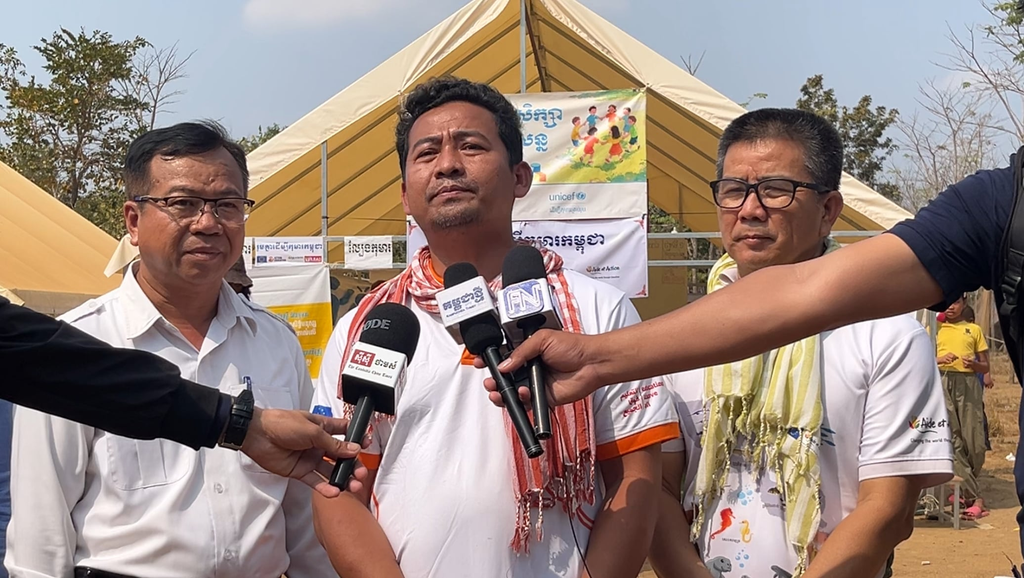
Vorn Samphors (C), country director of the NGO Aide Et Action Cambodia, is interviewed at the Wat Bak Thkav Safe Center. Photo: Meng Seavmey,
The NGO also supplied 30,000 children with studying packages that included notebooks, coloring papers and coloring pencils, Samphors said. As many as 30,000 school uniforms were distributed to the children, along with 30,000 backpacks, 5,000 sport materials as well as 15,000 books, he said. The association also provided 10,000 packages of tents, mosquito nets and blankets; 5,000 cases of milk and 5,000 food packages for students and their families, he added.
The Cambodia-Thailand border conflict has left destruction, including the destruction of children’s opportunity to study, he said. Education is one of the core components for a country’s development, which is why students must keep studying regardless of the location and time, Samphors said.
“We hope to give them knowledge and skills, so that they can still become the backbone of the country after going home, in terms of both national defence and national development,” he added.
Samphors also stressed that support from the public is essential to continue to provide emotional and material support to the children affected by the conflict so they can continue to attend school and also understand the need for education. And this will require the support of the authorities and the donors as long as the border conflict has not been fully resolved, he added.
Disclaimer: This article was first published on the Cambodianess News website and is reproduced here with permission. Click here to access the original post.