
By: Jade McCulloch and Sopheak Srey
Nearly a year has passed since fighting along the Cambodia–Thailand border first forced families from their homes. Renewed hostilities in December 2025 brought another, far larger wave of displacement before a ceasefire was reached later that month.
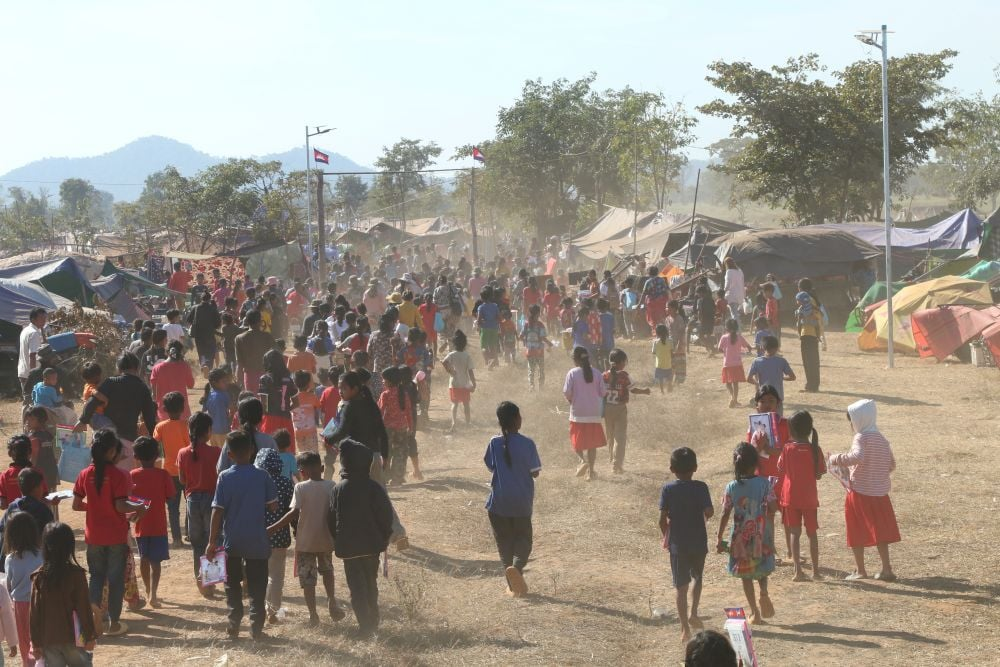
As families rebuild their lives and search for permanent homes, thousands of children remain affected. For many, returning to education has been a struggle. Some have fallen behind, and the disruption to their education has continued long after the fighting stopped.
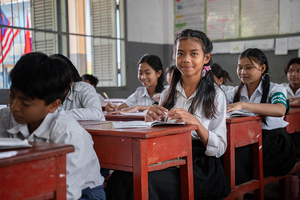
One of them is 12-year-old Kha Sreymich, a Grade 5 student from Ta Moan Senchey Primary School, who has studied in five temporary locations since her family was displaced. From early July, she has been learning at LASED III in Pong Ro commune, about 70km from her home in Ta Moan village. Her family’s house was destroyed by shelling.
Each time they moved, Sreymich had to leave more behind. During the first displacement, she managed to take her school bag, books and clothes. The next time, there was barely enough time to gather anything. This time, she carried only some exercise books and reading books.
Her father said, “I want to go home, but we can’t.” It is a simple sentence, but it captures what the past months have meant for families like his. Before the conflict, the family of seven relied on several members being able to work. Today, much of that income has disappeared. The family depends heavily on humanitarian assistance.
For children, the consequences of displacement extend outside disruption to their education because when a family is forced from its home, a child can also lose friends, routines, books, familiar teachers and a sense of stability.
And that is why months after the fighting, the question goes beyond the reopening of schools. What matters is whether children who were forced to leave have been able to continue their education.
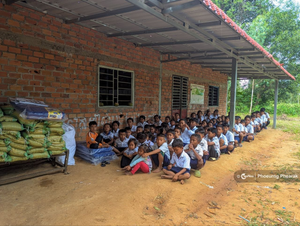
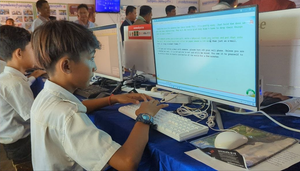
For many children, education continued in temporary learning spaces, host schools and alternative classrooms. Some used computers and tablets for digital learning. Others relied on emergency learning materials, reading books and self-study. Remedial classes have helped some students catch up.
As part of emergency education measures, together with government and partners, 207 temporary learning spaces, child-friendly environments and mobile libraries, reaching more than 36,000 children, alongside nine fixed-structure classrooms have been established.
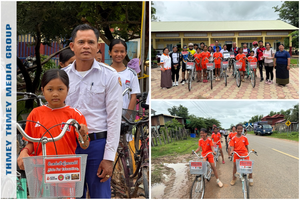
More than 23,800 children received learning kits, while thousands more received uniforms, school bags, notebooks and reading books.
But emergency education is not the same as stable education. Children who have missed weeks or months of lessons cannot always simply walk back into a classroom and pick up where they left off.
They may have fallen behind academically. They may struggle to prepare for examinations. Some may be anxious or withdrawn. Others may be at risk of dropping out entirely because their families have lost their livelihoods.
Teachers too have faced their own challenges. Temporary classrooms can contain children at very different learning levels, and teachers are expected to cover missed curriculum while supporting children who may have experienced trauma, displacement and loss.
These teachers need training in accelerated learning and psychosocial support, as well as support for their own well-being.
For families who have lost their incomes, the costs associated with education can become increasingly difficult to afford. Uniforms, school supplies, food and transportation all add to the financial pressure.
For a family struggling to rebuild a home and find work, ensuring children can remain in education can become a whole other challenge. This is why education recovery must go beyond rebuilding school infrastructure.
The focus now must be on children whose education has been disrupted. This means building safe and permanent classrooms with water and sanitation facilities, adequate furniture, electricity and digital access.
Expanding remedial and accelerated learning can support children who have missed education and help them to prepare for exams. Psychosocial support should be part of education rather than an afterthought.
The emergency response in Cambodia has already shown what coordinated action can achieve. So far more than 4,000 children have received psychological counselling or trauma referrals. More than 36,000 people have participated in child protection and safeguarding training.
Digital learning initiatives have also supported schools, including the expansion of the Primary Learning Programme across around 200 border schools and the establishment of 18 learning labs equipped with hundreds of computers.
But recovery takes time. Sreymich offers a glimpse of both the damage and the possibility. Despite moving between five temporary learning locations, she has not given up on school. She achieved third place in Grade 4 and is now ranked second overall in Grade 5. She attends school from Monday to Saturday and says she has never missed a class.
When she is not studying, she helps her family cook and wash dishes. She is also learning English at the camp. And she wants to become a teacher.
The classrooms have changed, her friends have been scattered and her home has disappeared, but her determination to continue her education remains.
The damage caused by conflict is often measured in destroyed buildings, displaced populations and economic losses. But some of the most significant consequences are harder to count.
Today, September 9, the world marks the International Day to Protect Education from Attack, a reminder that schools and education must not become casualties of conflict. While buildings and infrastructure are important, protecting education is about protecting children’s right to education, their relationships, their routines and their hopes and dreams for the future.
Nearly a year since the conflict, Cambodia’s displaced children have shown remarkable resilience. But resilience should never become an excuse to expect children to carry the burden of recovery alone.
Sreymich still wants to go home. Until she can, every safe classroom is a small step towards that future. When she finally does, her education should not have been left behind.
Jade McCulloch is director of engagement at Educate A Child programme of Education Above All Foundation.
Sopheak SREY is communication and partnership manager at Action Education in Cambodia.
Education Above All Foundation, with its partner Action Education, supports efforts to ensure displaced children have access to quality education.
Disclaimer: This article was first published on the Cambodianess News website and is reproduced here with permission. Click here to access the original post.