

By Kuch Sikol
While Cambodia pays close attention to the digitalisation of education by working with relevant organisations, children in a floating village on the Tonle Sap are facing an uncertain future due to a lack of opportunities and access to physical high school education
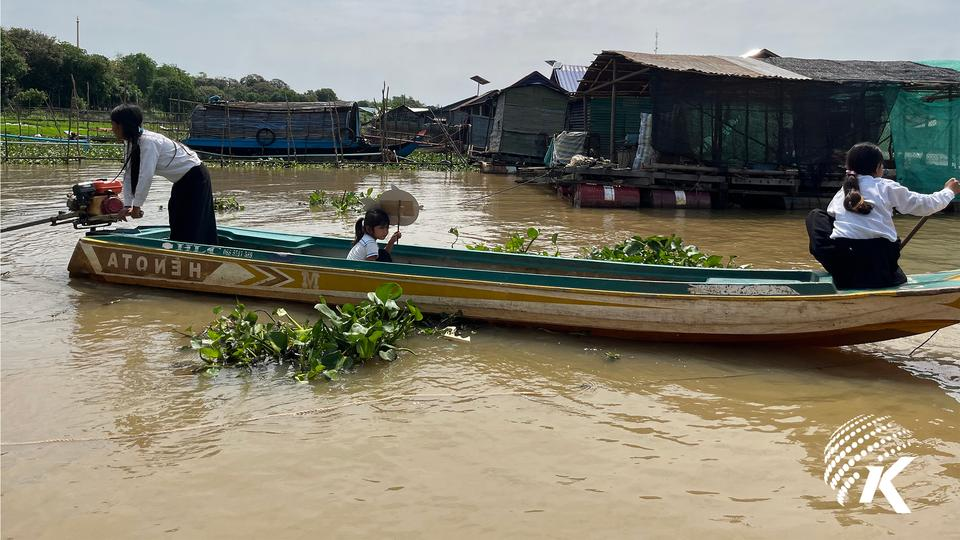
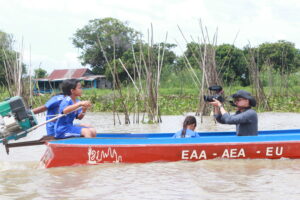
Students return from school by boat in Koh Chivaing Commune, Ek Phnom District, on March 18, 2025. Kiripost/Kuch Sikol
Only aged 15, Vorn Aliza, travels 14 kilometres along the river to attend Pray Chas Secondary School on the Tonle Sap, a trip she enjoys but does not think will last. In a couple of years, she will need to leave for high school, but her heart is heavy as she will be forced to move far from her family.
“There is no hope of continuing my studies,” Aliza said, her face glum. Even though children in her village, situated on the northwestern side of the lake in Koh Chivaing commune, Ek Phnom district (about three hours from Siem Reap), must learn to boat to school, most do not expect to pursue their tertiary education; a situation that is worse for girls.
Despite the opportunity to access primary and secondary education, they cannot progress further in their studies because there is no higher level education nearby, and life in the village is difficult. This makes it hard for them to leave their parents – mostly fisherfolk – behind.
“I want to continue my studies because I dream of becoming a teacher. However, my parents are poor and I have younger siblings. If I attend high school, it will be far from home and my parents cannot afford to support me,” she lamented.
Family comes first, Aliza asserted, adding, “My family is my priority because it is different to see them struggle.”
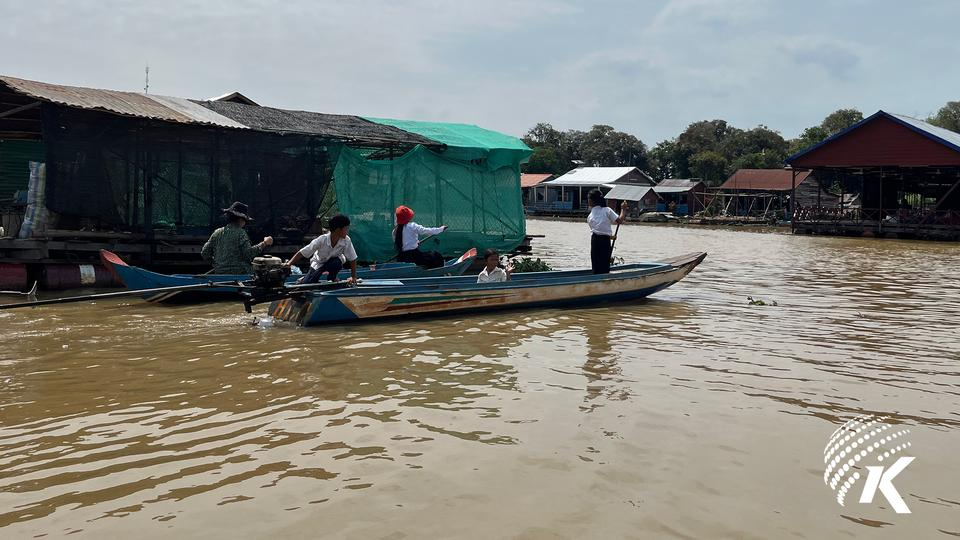
Students return from school by boat in Koh Chivaing Commune, Ek Phnom District, on March 18, 2025. Kiripost/Kuch Sikol
Ath Chariya, a 14-year-old in Grade 8, previously studied at another primary school but is schoolmates now with Aliza at Pray Chas Secondary School. She too expressed a mix of hope and sadness. Although she is hopeful about continuing her education with her family’s support, she feels sad for her friends who have already dropped out of school to help their parents.
“My mum encourages me to continue, even though she’s worried the school is a bit far from home. But I feel sad for my friends who dropped out of school, and some are unsure if they will continue their education,” she shared.
Most students at Pray Chas Secondary School come from four primary schools. Some of the schools are far away, requiring travel by boat, therefore making it difficult for students to attend.
As a result, nearly all of the students at Pray Chas school stay in dorms and use boats for transportation, with study materials supported by several organisations, including Action Education in partnership with the Education Above All (EAA) alongside Aide et Action (AEA).
Vorn Samphors, Country Director of Aide et Action, explained that the school was the initiator of the dorm, with his organisation playing a role in its creation. He emphasised the importance of providing a safe and comfortable environment for children, especially considering the challenges of travelling by boat, which is the main means of transportation.
“We support this because we want to encourage all children to continue their education after primary school,” he said.
EAA has partnered with AEA since 2014 to support marginalised children in Cambodia through scholarships, school construction, teacher training, and providing bicycles and rowboats to improve school attendance, as 5,256 children are at risk of dropping out of school.
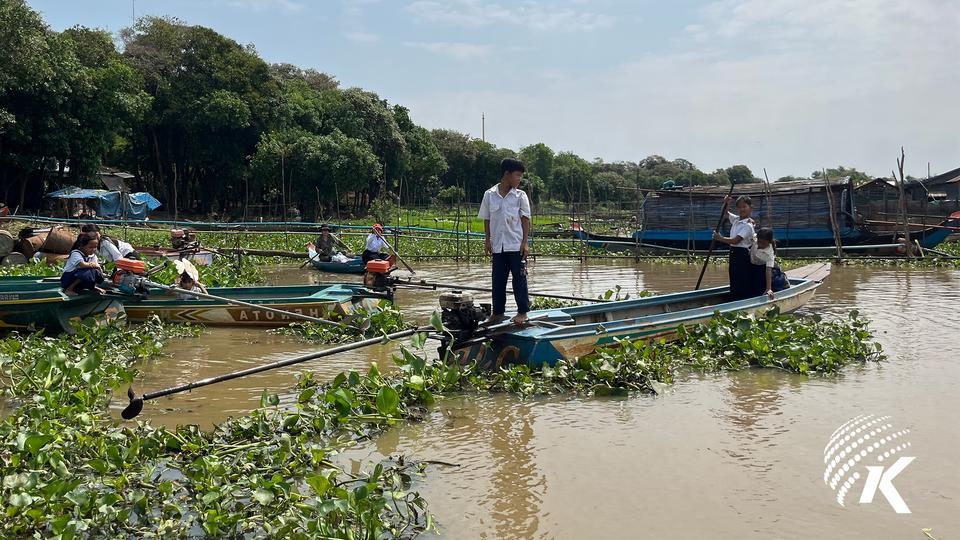
Students return from school by boat in Koh Chivaing Commune, Ek Phnom District, on March 18, 2025. Kiripost/Kuch Sikol
Dreams of community high school grows
While the schools in Koh Chivaing receive support from relevant parties, students still lack the opportunity to pursue their dreams through higher education.
Aliza mentioned that if a high school was nearby, she would choose to continue her education as it would be more affordable.
“It won’t cost a lot, and I can help my parents during the weekend when I don’t have school. I can at least complete my Grade 12 studies, as intended by my parents,” she said.
Aliza hopes more focus on various opportunities will be given to students as many have little hope to study further seeing that their families struggle to meet even basic needs.
Chariya said she would be happy if there was a high school nearby so they can all continue their studies. “My friends often tell me they can’t continue their studies after secondary school because their parents can’t afford [to send them] and would rather stay close to them. But if there was a high school here, I think they would continue. Many are thinking of giving up at the moment.”
Job scarcity restricts children’s dreams
“I want to be a teacher because I want to help other kids access education,” said Sing Bunleap, a 10-year-old student at Bacprea Primary School, when asked by Kiripost why many children in his area aspire to become teachers. Bunleap explained that aside from fishing, the jobs he sees around him are either policemen, nurses or teachers.
However, he was “inspired” to become a teacher so he can share his knowledge with the children in his community.
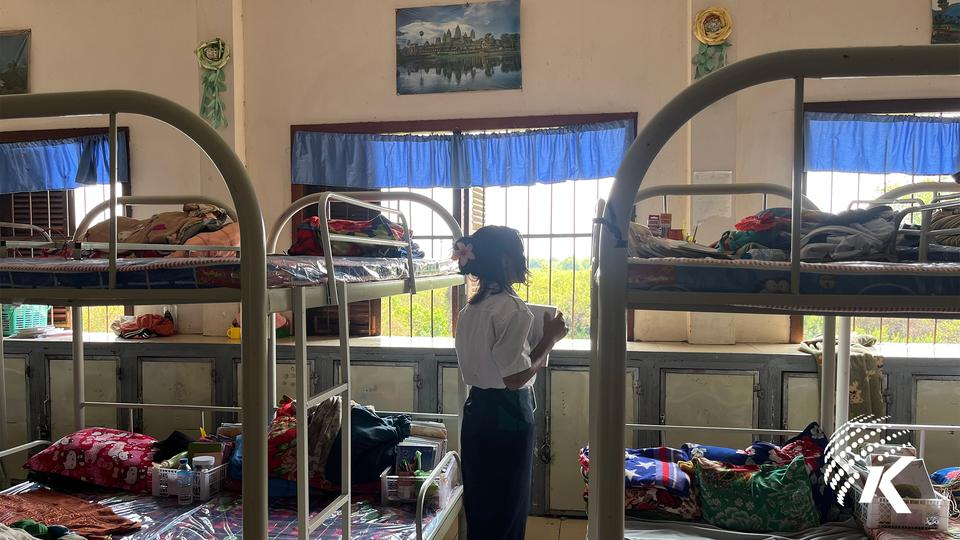
Vorn Aliza, a student at Pray Chas Secondary School, prepares for class at the dorm she stays in. Kiripost/Kuch Sikol
Aliza also voiced a similar desire to become a teacher, as most of the teachers in her community motivated her to be like them as it is a “bit hard to understand how the other jobs work”.
“I don’t know much about other jobs. I only know a little from what we learn, but I still don’t know how other jobs work,” she remarked.
Another teaching job dreamer, Chariya, said she cannot explain what motivates her, only that, “I know I want to be a teacher in the future”.
Kiripost was unable to contact Khuon Vichheka, spokesperson for the Ministry of Education, Youth and Sport, to obtain details of any plans or mechanisms to support these schools.
Jade McCulloch is director of engagement at Educate A Child programme of Education Above All Foundation.
Sopheak SREY is communication and partnership manager at Action Education in Cambodia.
Education Above All Foundation, with its partner Action Education, supports efforts to ensure displaced children have access to quality education.
Disclaimer: This article was first published on the Cambodianess News website and is reproduced here with permission. Click here to access the original post.