

By: Chhuon Kongieng
PHNOM PENH – The rise of artificial intelligence (AI) is transforming education by enhancing learning and performance for students and educators alike.
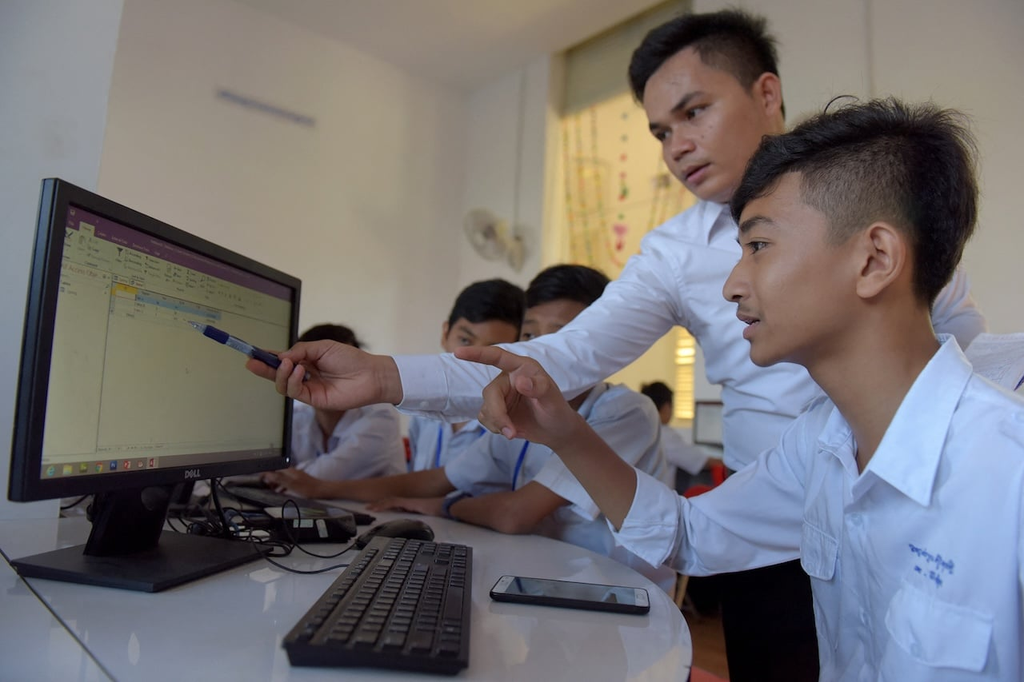
This photo taken on June 26, 2018 shows Cambodian students and a teacher using a computer in a modern classroom built under Prime Minister Hun Sen’s administration campaign for the “new generation” schools programme in Phnom Penh. Photo by AFP
In Cambodia, there is a focus on adapting to new technologies as the education system digitizes. Initiatives such as the EdTech App and the Primary Learning Program (PLP) are being implemented to modernize education.
Following the celebration of Teacher’s Day under the theme “Teachers as the Catalyst of AI Transformation,” the Ministry of Education, Youth and Sport launched the two AI feature applications on October 10.
The EdTech App is for students and teachers in secondary and primary schools, along with the updated version of the PLP for grades 1 to 6.
Teachers’ Role in AI Transformation
Vorn Samphors, country director of Aide et Action Cambodia, said teachers are at the core of developing the country’s human resources and are the key drivers of digital and AI transformation.
“Now, teachers can use AI to help with lesson planning and preparing exercises for students, making their work more effective and competitive,” Samphors said.
He said information and knowledge exist in many forms and places, requiring assistance from AI technology to read and collect them.
Similarly, teachers can use AI tools to support their roles in teaching, assigning and collecting exercises and homework from students.
Samphors said it is a good sign that teachers and the public are increasingly able to use technology, especially when accessing information through Google and Facebook.
He said data is now being integrated into the education system to help teachers. However, it is essential to ensure that digital tools provide accurate and reliable information for teachers to use in guiding their students.
“In general, I encourage teachers at all grade levels to use digital technology to improve their knowledge and teaching skills,” he said.
“However, when it comes to students’ use of AI, I would like to see a gradual decrease of AI usage from higher education to secondary schools, minimal use in primary schools and almost no use at all in kindergarten.”
He also said that children in kindergarten should learn more through physical interaction, play, and relationship building, as these are more beneficial for their development.
Samphors said the Ministry of Education has already launched AI applications in education programs for teachers.
With these tools, teachers from both rural and urban schools can better track and assess students’ performance in the classroom.
Challenge and access to digital learning tools
The main challenge in implementing AI-assisted digital learning lies in teachers’ commitment to learn and students’ access to the internet and digital tools.
According to Samphors, learning about AI is challenging for some teachers who struggle to keep up with technology but many are making great efforts to build their AI skills.
Many teachers use their own computers, so they can now find different strategies for teaching.
However, the challenges often are encountered by students. Some have limited access to digital learning tools such as computers. But they are encouraged to study harder and take responsibility for their learning.
Samphors said Aide et Action Cambodia also works with the Ministry of Education to identify committed schools each year to support with digital tools and provide training for teachers.
This support helps ensure better performance for teachers and learners.
“Developing a country requires strong human resources, and teachers play a vital role in educating children to become the next generation with capacity, quality and integrity,” Samphors said.
He also pointed out that to contribute to the digital learning process, Aide et Action Cambodia set up computer labs in more than 120 schools, enabling around 5,000 students to study and complete tests using computers and tablets.
He also urged parents and local authorities to take part in the process to accelerate the learning journey as they can ensure proper internet access and provide digital tools for students and teachers.
“Such support can help build a stronger learning environment and create the human resources needed for the country’s development,” Samphors said.
According to the Ministry of Education, the EdTech App is designed for students from grades 7 to 12. The app enables teachers to prepare tests and includes a national adaptive innovative testing system, monthly and semester examination features, and tools for tracking and analyzing students’ progress.
It also provides learning assistance and offers competitive study opportunities with grading at both the national and international levels.
The app also integrates SEA-PLM (Southeast Asia Primary Learning Metrics) and PISA (Programme for International Student Assessment) tests, which are international student assessment systems.
Jade McCulloch is director of engagement at Educate A Child programme of Education Above All Foundation.
Sopheak SREY is communication and partnership manager at Action Education in Cambodia.
Education Above All Foundation, with its partner Action Education, supports efforts to ensure displaced children have access to quality education.
Disclaimer: This article was first published on the Cambodianess News website and is reproduced here with permission. Click here to access the original post.