

Nop Sreymao
Synopsis: Khnat Primary School in Siem Reap province is quietly transforming autism education in Cambodia with inclusive, specialised classrooms that nurture growth, independence, and hope – offering children on the spectrum a rare chance to thrive and families a glimpse of a brighter, more compassionate future.
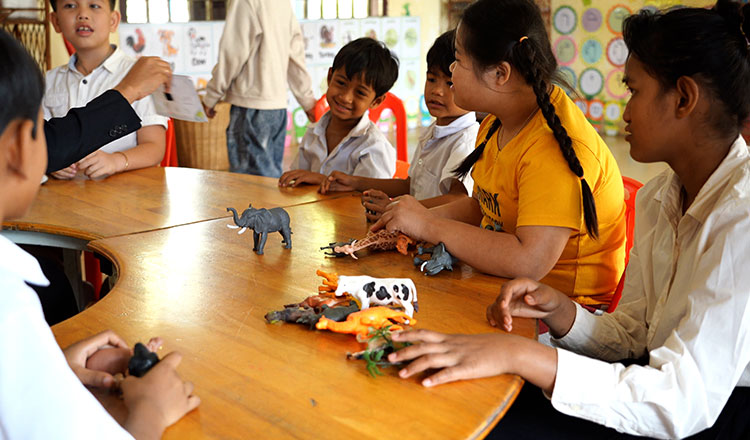
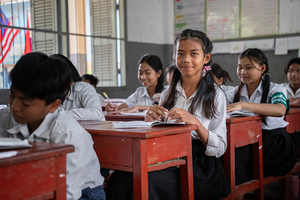
Autistic students learn about animals in Khnat Primary School in Siem Reap province. AEA
In a quiet corner of the Siem Reap province, where the hum of traffic gives way to birdsongs and the rustle of leaves, stands a school that’s quietly rewriting the story of autism education in Cambodia.
Here, classrooms have become sanctuaries of understanding. Instead of rigid routines, there are flexible, nurturing spaces where children on the autism spectrum can feel safe to explore, express, and evolve at their own pace.
Each smile, each word spoken, and each new behaviour learnt is not just a milestone – it’s a miracle in motion.
“For our students, every small step is a victory. For our teachers, every spark of understanding is a powerful reminder that education can truly change lives,” said Hout Heng, the passionate and determined principal of Khnat Primary School, in an interview with Khmer Times.
“This mission is beyond important; we do not want the autistic kids to be left behind,” Heng explained. With pride in his voice, he described how the school runs two specialised classes – one in the morning and one in the afternoon – dedicated exclusively to autistic students.
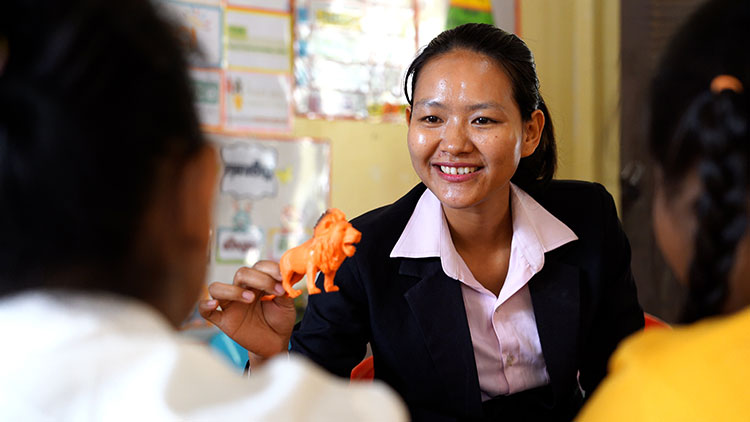
A teacher guides autistic students in class at Siem Reap’s Khnat Primary School. AEA
Each class is guided by well-trained, compassionate teachers who bring not only expertise but a deep sense of commitment to inclusive learning.
In these classrooms, progress isn’t measured by grades alone. It’s seen in the joy of a child making eye contact for the first time, in the confidence of raising a hand, or simply in the peaceful focus of a student absorbed in a sensory activity.
This is a place where differences are not just accepted – they are celebrated, said Heng.
Khnat Primary School is proving that with the right support, structure, and heart, children on the autism spectrum can thrive – and that the future of education lies in embracing every child’s unique way of learning.
Since 2016, Khnat Primary School has quietly nurtured a space where autistic children can flourish – and sometimes, even soar beyond expectations. The school principal proudly shared that two students have successfully transitioned into mainstream classrooms, learning side by side with their peers.
“We welcome all children with autism from the age of six and up, and we really hope to help them integrate themselves into the normal classrooms with other children,” he said with a hope in his eyes. “Right now, we have 15 students between the ages of eight and 11 in our special classes.”
These vibrant, inclusive classrooms are made possible with the vital technical and material support of the Rabbit School Organisation – which has been working for children with intellectual disabilities in Cambodia for over 25 years – helping turn a small corner of Cambodia into a beacon of possibility for children on the spectrum.
The initiative is also supported by Aide et Action Cambodia in collaboration with Education Above All Foundation – a foundation that serves globally with a mandate to advance education, development, and advocacy worldwide.
In Cambodia, an estimated 5% of the population lives with some form of disability, yet children with autism remain among the most marginalised.
With limited educational resources and widespread social stigma, families often have no choice but to keep these children at home.
Peering through the classroom window, Ouch Chantrea watched her autistic daughter, Linna, with quiet pride etched across her face.
Her eyes, filled with a mix of love and longing, held a glimmer of hope, as if, in that moment, she could see the outlines of a brighter future slowly taking shape for her little girl.
In Linna’s focused gaze and calm presence, Chantrea didn’t just see a student – she saw possibility.
“I am beyond grateful that the Khnat Primary School is offering this class for my daughter and other kids here,” she said. “I used to send my daughter to private schools, but it was never easy.
There was no such special class for students with special needs, and it was heartbreaking to witness my daughter suffer each day just to fit in the class.”
Chantrea said she has seen a remarkable transformation in her 13-year-old daughter Linna after two years in Khnat’s specialised autism class.
“She’s more focused and more responsive and can do basic activities such as using the bathroom, showering and eating by herself without the support of an adult anymore,” Chantrea said, her voice tinged with both relief and joy. “The progress may seem small to others, but to me, it’s a world of change.”
“I never imagined my son would one day enjoy learning, let alone interact with others,” said Samnang, another parent of an autistic kid. “Before coming to Khnat Primary School, Dara couldn’t stay in a classroom for more than a few minutes. Most schools just didn’t know how to support him.”
Education, Youth and Sport Ministry spokeswoman Khuon Vichheka said the Ministry has implemented a range of inclusive education programme aimed at supporting children with special needs across the country.
These initiatives include tailored learning materials, adapted curricula, and specialised classroom support.
She added that MoEYS has also introduced dedicated training sessions for teachers, equipping them with the skills and knowledge necessary to effectively teach and support students with diverse physical, cognitive, and developmental challenges.
Dr Quach Mengly, a renowned educational expert in Cambodia, emphasised the importance of broadening support systems for children with diverse learning and developmental needs.
He noted that while autism often receives more public attention, it is only one of many challenges’ children may face in their educational journeys.
“Autism is just one among many other problems that children may face, and we know that there are still high demands for this support for them,” said Dr Mengly.
He added that increased investment in specialised resources, teacher training, and early intervention programmes is crucial to ensuring that no child is left behind, regardless of their abilities.
The World Health Organization reported in last November that one in 100 children worldwide is diagnosed with autism.
However, some well-controlled studies have indicated significantly higher prevalence rates. Additionally, the prevalence of autism in many low- and middle-income countries remains largely unknown.
Jade McCulloch is director of engagement at Educate A Child programme of Education Above All Foundation.
Sopheak SREY is communication and partnership manager at Action Education in Cambodia.
Education Above All Foundation, with its partner Action Education, supports efforts to ensure displaced children have access to quality education.
Disclaimer: This article was first published on the Cambodianess News website and is reproduced here with permission. Click here to access the original post.