
By: Marissa Carruthers
KEP & KAMPOT: At the age of 32, Paet Souheng has endured a tough life. Up until four years ago, he spent most of his time away from his home in Kep province’s Ou Krasar village, navigating the often rough seas working for a company catching and processing fish.
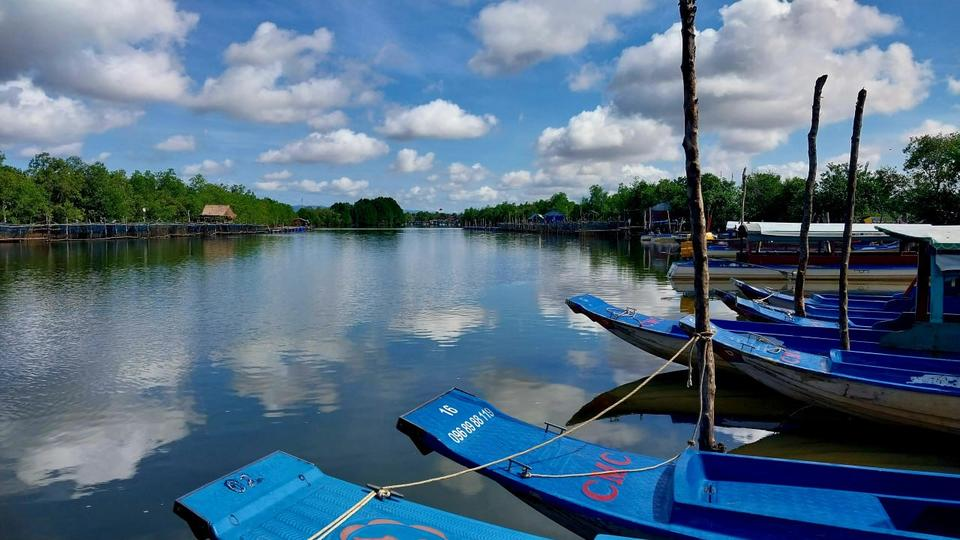
Some of the spruced up fishing boats used to give tourists boat rides at Trapeang Sangkae Community Fisheries. Kiripost/ Marissa Carruthers
In the second installment, Kiripost heads to Kep and Kampot provinces with Heifer International Cambodia to see how the EU-funded Co-SAVED project is transforming lives by providing the tools to support sustainable poultry, fish and duck farming, leading to increased incomes, improved food security and brighter futures for their families
“I was a fishing worker and it was hard,” he told Kiripost as he tended to about 100 newly-born chicks scurrying around in a brooder box. “I would spend most of my time at sea finding fish, often coming back with very little to sell. It was dangerous, hard, and I made very little money.”
Souheng longed to work from home, but when he returned was unable to find employment. Desperate to find work close by, he was inspired by his mother, who ran a small-scale chicken business. So, four years ago, he joined training delivered by Heifer International Cambodia.
“My mum sold chickens, but I’d never raised them before,” he said. “But I wanted to do something where I could work from home and earn a decent living. When I heard about Heifer’s work, I wanted to find out more.”
Through the consortium for sustainable alternatives and voice for economic development (Co-SAVED project), funded by the European Union and delivered by Heifer Cambodia in partnership with AEA, Souheng learned the skills to successfully run a poultry farm, from raising and breeding chickens, to livestock management, hygiene and caring for eggs.
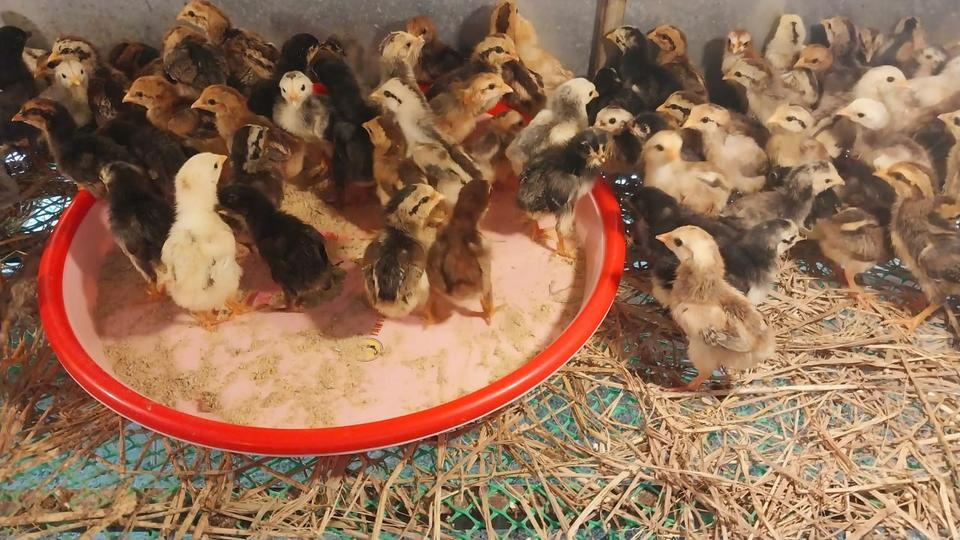
Some of the chicks being raised by Paet Souheng at the chicken farm he operates from his home in Kep province. Kiripost/ Marissa Carruthers
Today, he has scaled his business to about 80 chickens. They produce between 200 and 300 chicks a month, which can be sold for 3,000 to 3,500 riel, directly to market, as well as restaurants and members of fishing communities in the area. He also plans to start breeding chickens to sell to other farmers.
“Since starting the poultry farm, things have completely changed. The main transformation is that I trust myself. Before, I never believed I could ever raise a lot of chickens. Now, I believe in myself and feel very proud of what I have achieved.”
In fact, Souheng has grand plans to further expand his business. On land at the back of his family’s stilted wooden home, he is in the process of building a further 20 blocks to breed chickens, proudly revealing he wants to scale his business to supply more than 1,000 farmers.
“I want to carry on learning new techniques, so I can expand my business even more,” he said. “I now feel encouraged and confident enough to do this.”
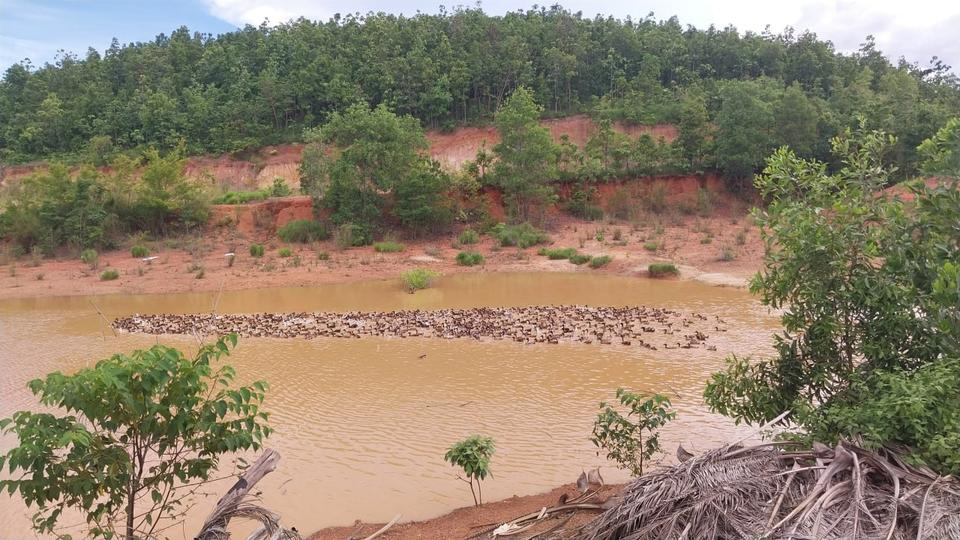
Some of the ducks being raised for eggs at a duck farm in Kampot province. Kiripost/ Marissa Carruthers
Fishing for a prosperous future
Over in Kampot province, the establishment of a community fishery has proved a lifeline for its 914 members. Trapeang Sangkae Community Fisheries launched in 2009 and officially registered with the Ministry of Agriculture, Forestry and Fisheries (MAFF) in 2011. The majority of the community today are engaged with fishing, farming, aquaculture, and duck and chicken farming.
“Before, families in the community didn’t have much income. Fishing was hard and fish stocks were depleting,” said community chief, Him Sim. “The kids would often drop out of school and go with their parents to work, or find other income.”
However, today, life is very different. In 2022, under the Co-SAVED project, Heifer Cambodia and partners delivered extensive training and support for nine fishing farmers. In addition, in 2023, Heifer Cambodia supported providing a network of fishing net-houses, meaning fisherfolk no longer have to spend their nights out at sea,
“This makes it much easier for the fishers, because with fish farms, they spend much less time. If they fish in the river or sea, they spend a full day and night, and perhaps catch nothing,” Sim said.
Currently, 40 fish farmers have invested in fish net-houses after noting how the fishers Heifer Cambodia and partners supported have benefited. In total, 120 fish net-houses line a stretch of the river next to the community base.
To further boost the community’s income, it has also established an eco-tourism project, inviting visitors to immerse themselves in community life. And with all of these additional avenues of income, life is looking up for the people of Trapeang Sangkae.
“With the new businesses and techniques, like the fish net-houses, duck farming and ecotourism, we can make more income and there’s no need for children to go to work. Even though they’ve not become rich families, they make enough to eat, support the family and send their children to school. It’s amazing to see the change,” Sim added.
Mak Him recalls spending long nights out at sea, battling storms and fearing for his life; often with very little financial reward. Like many other members in his community, he was riddled with debt after being forced to borrow money from relatives and loan sharks.
“Now that we have the fish houses, I’ve stopped sea fishing. It’s a very hard job and requires a lot of strength pulling in the nets as they’re very heavy. But the biggest challenge was the weather. If there’s a storm, it’s dangerous and we often come back with nothing,” he said.
“I also had to borrow money off my parents and outsiders because we didn’t have enough money for food. I have a much better life now and don’t need to borrow any money from other people.”
Committee member Him Ny told Kiripost that the creation of the community has been key to its success. Prior to its formation, he recalled the area being plagued with illegal fishing and overfishing, which led to seriously depleted fish stocks.
In addition, the area was rife with land grabbing, leading to a severe depletion of mangroves, which are vital fish breeding and feeding grounds. However, when Trapeang Sangkae Community Fisheries registered with MAFF, the ministry designated them protected areas for fishing. Members have also been allocated to patrol these areas.
Through the ecotourism initiative, guests can also plant mangroves, helping the community to restore its natural resources and increase fish stocks. “Our ultimate aim is to protect traditional jobs, like fishing, and protect the environment, as well as livelihoods,” Ny said.
“I’ve now had a fish farm for three years and because of this job, I can support my three children to go to school and then university. I also have more hope for the future of the children here than when I was growing up; the children in this community now have more opportunities.”
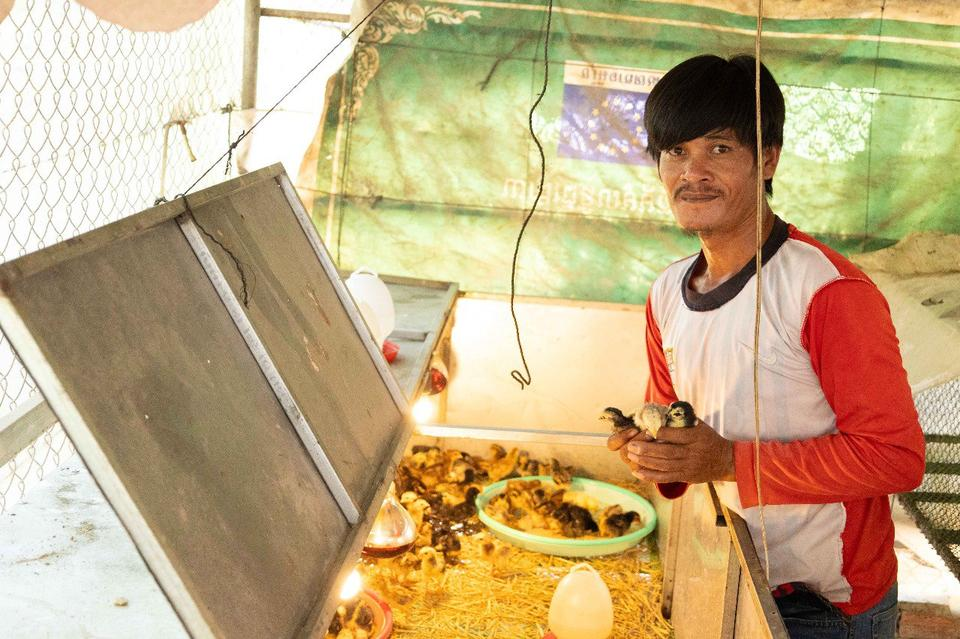
Paet Souheng with some of the chicks at the chicken farm he runs from his home. Kiripost via Uth Sophea (Heifer Cambodia)
Hatching hope for the future
Down a bumpy, narrow dirt path only fit for a motorbike that winds through seemingly endless patchworks of paddies and farmland deep into the countryside from Trapeang Sangkae Community Fisheries, sits a sprawling duck farm that is home to more than 1,000 of the birds.
The model duck farm in a remote part of Kampot province is operated by three partners who hail from Trapeang Sangkae. Every day, they make the jolting journey to care for their livestock, feeding them, cleaning out their pens, gathering eggs for sale and incubating others to breed.
Math Rositi, Sun Dulseth and Sein Yousos stand in front of a vast pond swarming with a flock of quacking ducks as they clutch a carton of eggs. Rositi recalls life being a struggle, earning little income selling rice to feed chickens.
However, in 2022, Rositi and his business partners decided to start rearing ducks to fill a gap in the market, receiving financial support from Heifer Cambodia to buy feed and livestock. Under the Co-SAVED project, they also received extensive training in duck rearing, including elements such as vaccinations to lower the death rate.
Today, they have more than 1,000 ducks that produce about 500 eggs daily for the market, with each egg fetching between 4,300 and 4,500 riel. They also have plans to scale up operations to 3,000 ducks.
“Through the duck farm, we now make enough income to support our families and our children can go to school,” said Rositi, who is also a teacher in his community.
“One challenge now is that it’s more difficult to find a market because when we started, there were only a few farmers raising ducks. When people saw our success and that we made a profit, they started. But when we expand the business, we hope this will change.”
According to Heifer Cambodia, as of December 2024, the Co-SAVED project has supported 11 community fisheries, with 2,738 families directly benefitting. A further 123 self-help groups have been formed, and 91 poultry, fish and prawn farmers have received support.
This has in turn helped farmers increase their income, with poultry farmers making $9,890, fish farms $10,020 and prawn farms $4,660.
Read Kiripost’s first instalment, which focused on farmers in Kampong Speu province, here.
Jade McCulloch is director of engagement at Educate A Child programme of Education Above All Foundation.
Sopheak SREY is communication and partnership manager at Action Education in Cambodia.
Education Above All Foundation, with its partner Action Education, supports efforts to ensure displaced children have access to quality education.
Disclaimer: This article was first published on the Cambodianess News website and is reproduced here with permission. Click here to access the original post.