

By: Teng Yalirozy
BATTAMBANG— As dawn breaks through the mist over Tonle Sap Lake, the rhythmic hum of boat engines signals the start of daily life in the floating village of Prek Toal. In the darkness, a wooden home stirs awake—part grocery store, part homestay, and wholly a lifeline for a family of seven.
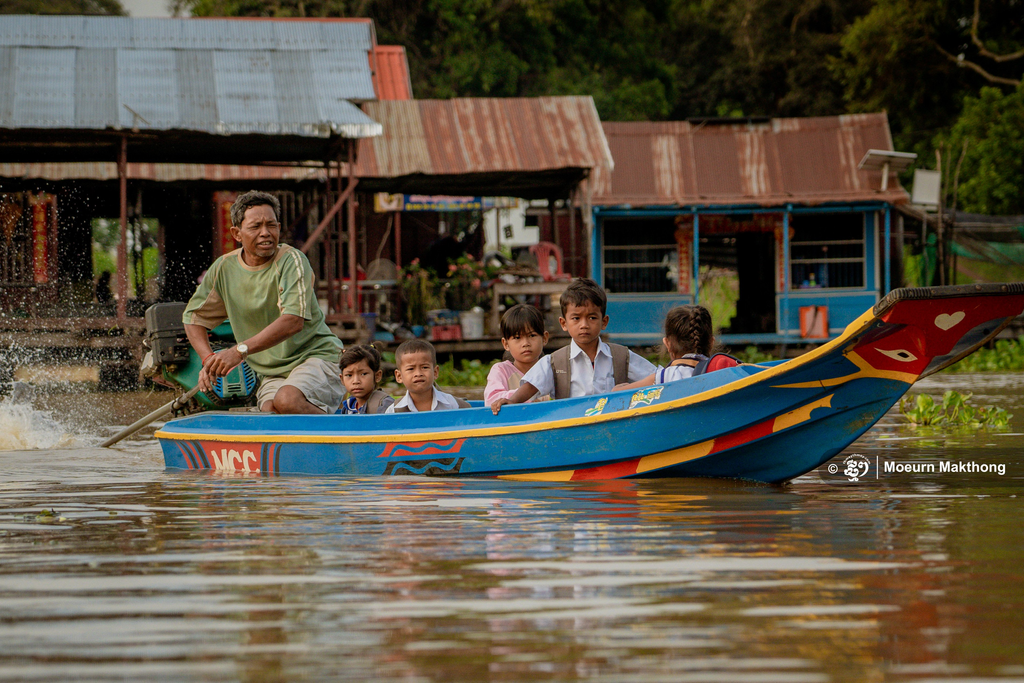
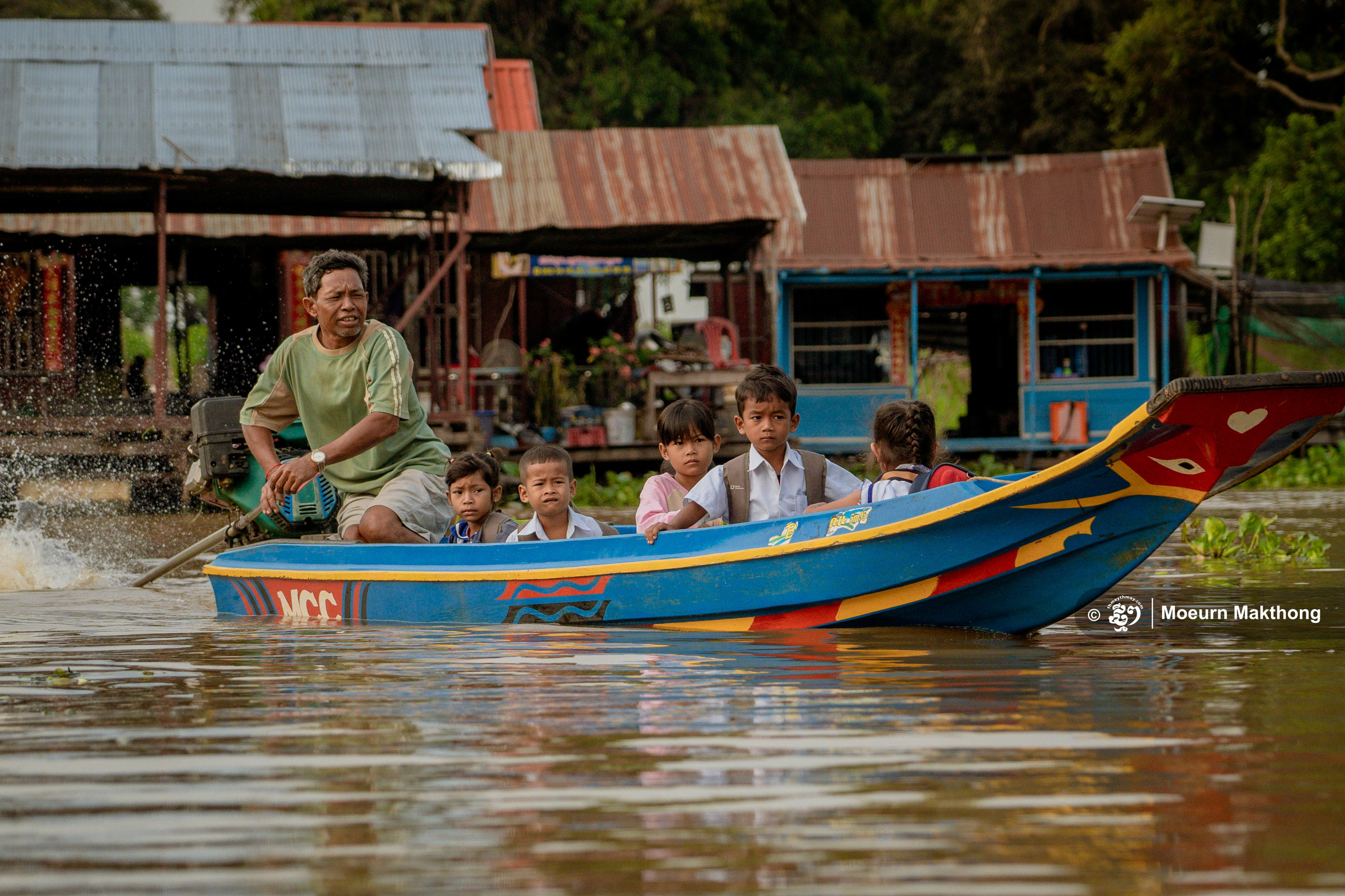
A father drives his children to school in the floating village of Prek Toal. Photo: Moeurn Makthong
This floating household, nestled in Koh Chiveang commune in Aek Phnum district, is run by three young sisters who inherited the business from their parents. Theng Thida, the eldest at 23, manages operations alongside her 17- and 15-year-old sisters. All three once dreamed of completing their education. But today, only the youngest, Theng Ammara, remains in school.
“I don’t want to be stuck here running the business like my mother,” said Ammara, 15, as she passed a steaming cup of noodles to a customer before heading to class. “Education is very important for my future.”
For Ammara, life on the water means isolation—from opportunities, from guidance, from the world beyond the lake. Her dreams are confined to the few role models she has seen.
“I don’t know, but I want to be a teacher so I can help other children in this village,” she added, adjusting her school uniform.
The youngest, Theng Ammara, remains in school. For Ammara, life on the water means isolation—from opportunities,~m guidance, from the world beyond the lake. Her dreams are confined to the few role models she has seen. Photo: Teng Yalirozy
Her mother, Prerng Sopheap, wants a brighter future for her children—but fears the risks involved in getting there.
“They told me they wanted to study, but I just can’t let them go,” she said. “There are no relatives on land to help. It’s dangerous.”
The walls of their floating home are lined with certificates—testaments to her daughters’ academic promise. Thida, the eldest, had to leave school after Grade 9 to help the family when their finances were dire. Today, she sells goods online; her sister keeps the books; the youngest helps around the house. Sopheap and her husband now only assist occasionally, stepping back so their daughters can lead.
When Poverty Pulls Harder Than Hope
A few boats away, under the shade of a large tree, Nhem San sat in a squat, her three youngest children by her side. The March sun beat down as she recounted the painful choices she’s made.
“Some days when we couldn’t catch fish, we had nothing to eat. My children came to school hungry,” she said quietly. “They easily get sick, but I don’t want them to end up like me—illiterate and stuck in this floating village. I want them to go to university.”
San, a mother of six, has already seen three children leave school. Two are married. One works in construction on land to supplement the family income. Her husband, a fisherman, is the sole breadwinner. Despite the odds, San is determined to keep her youngest—ages five, ten, and eleven—in Kampong Prahok Primary School.
Her resolve is supported by organizations like Aide et Action, which provide school supplies, financial assistance, and help improve school facilities.
“I will try my best, despite any difficulty, to keep them in school,” San said.
Since 2014, Aide et Action (AEA) and the Education Above All Foundation (EAA) have worked together to support more than 5,200 marginalized children in Cambodia, said AEA Country Director Vorn Samphors. Their efforts include providing scholarships, school supplies, teacher training, and building schools, as well as offering bicycles and rowboats to help students get to class.
“Our key achievement is ensuring that disadvantaged children, families, and communities can access education,” Samphors said. “Encouraging children to attend school and realize their full potential opens the door to a better future—for both the individual and the community. That is our mission.”
San, a mother of six, has already seen three children leave school. Two are married. One works in construction on ~ San is determined to keep her youngest—ages five, ten, and eleven—in Kampong Prahok Primary School. Photo: Teng Yalirozy
Education by Boat and Boarding House
About 14 kilometers from Koh Chiveang commune, in Prey Chas commune, Prey Chas Secondary School has become a vital lifeline for students across Aek Phnum district. Since its founding in 2008, the school has welcomed children from five surrounding villages, many of whom must travel long distances by boat—some journeys taking over an hour.
To ease this burden and ensure students have a safe and supportive place to stay, dormitories were built on-site with support from Aide et Action (AEA)—an organization that has long worked to improve education access in Cambodia’s most vulnerable communities.
“This is something we support because we want to encourage all children to continue their education after primary school,” said Vorn Samphors of AEA. “Our goal is to ensure a safe and comfortable learning environment, so that students don’t have to choose between survival and school.”
Today, the dormitories house 36 boys and 27 girls—students who left their floating homes behind to pursue learning opportunities that would otherwise be out of reach.
One of them is Vorn Aliza, 15, who is currently in Grade 8. Though she remains determined, she worries she may not make it to high school.
“My chances of continuing are only 30 percent,” she said. “If I go to school, who will feed my younger siblings?”
Aliza’s older brother dropped out after Grade 4 to work in construction, helping support their parents, who rely on fishing to survive. Now, Aliza finds herself at a crossroads—torn between her dream of staying in school and the urgent needs of her family.
“I will regret it if I drop out, but I have to sacrifice,” she said.
When Families Can Afford to Dream
In the same school, 13-year-old Chhuo Phary, also in Grade 8, speaks of her dreams with hope.
“My family has always prioritized education,” she said. “I want to go to Aek Phnum High School. I want to help other children access education, because it lifts families out of poverty.”
Phary lives with her father, who recharges batteries for a living. Her older brother is a teacher in Battambang city and supports the family financially. Unlike many of her peers, Phary is not pressured to drop out—and she sees a clear path forward.
She is not alone. Her classmate, 14-year-old Khlern Manet, also wants to become a teacher.
“I feel happy when I go to school and get to learn,” said Manet, the youngest of five siblings. Her second brother, now in Grade 11, is still studying thanks to their oldest sister, who left school in Grade 3 to help their parents.
“My brother and I are committed to education—for our parents and our older sister,” she said.
Vorn Aliza, 15, is currently in Grade 8. Though she remains determined, she worries she may not make it to high school. Photo: Teng Yalirozy
A Future Too Far to Imagine
Not all children have the luxury of dreaming. Penh So Im, 14, has never left Bak Prea village. She started school late and is only now in Grade 6. Her family once lived on a fishing boat. They now stay in her grandmother’s abandoned house. Her parents farm in the dry season and fish when the rains come.
So Im struggles to imagine life beyond the lake.
“My oldest sister is out of school. Only my younger sister and I still study,” she said. “I don’t know what I want to do when I grow up.”
Her sister, Sophea, is 11 and in Grade 4. Neither girl has considered completing Grade 12. Life, as they know it, revolves around the lake, the family, and survival.
“I just know that when I go to school, I can read different books,” Sophea said shyly. “I think I love reading. But I can’t read every day—we take turns to go to the library.”
On Tonle Sap Lake, life moves gently. The water carries homes, histories, and hopes. But the stillness belies a quiet struggle. While some children dare to dream, others are anchored by poverty and isolation. Their futures are not yet lost—but they are, for now, adrift.
Jade McCulloch is director of engagement at Educate A Child programme of Education Above All Foundation.
Sopheak SREY is communication and partnership manager at Action Education in Cambodia.
Education Above All Foundation, with its partner Action Education, supports efforts to ensure displaced children have access to quality education.
Disclaimer: This article was first published on the Cambodianess News website and is reproduced here with permission. Click here to access the original post.