
Nop Sreymao / Khmer Times
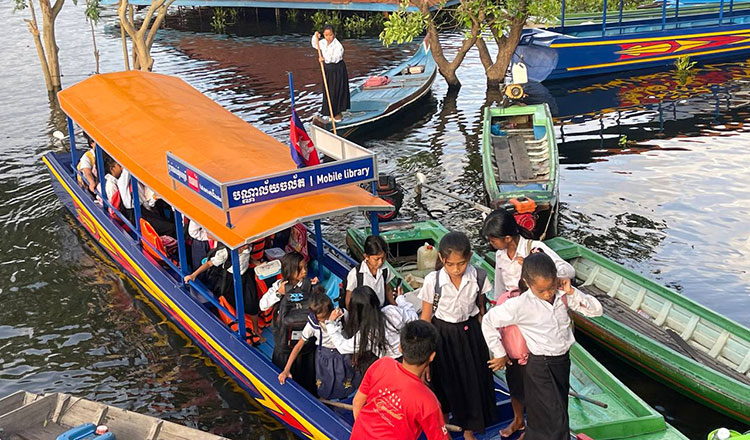
Students take turns to access books on the mobile boat library in front of Koh Chivaing primary school in Battambang province on March 13. Action Education
On the vast waters of the Tonle Sap Lake, where wooden houses rest on stilts and boats are used as everyday transport, a new wave of learning is transforming young lives. Two mobile boat libraries are bringing education directly to children in floating villages, ensuring that no young mind is left without the opportunity to explore the world through reading.
This initiative, launched by Action Education in collaboration with Education Above All (EAA), aims to break the barriers to education in these remote communities. In a region where access to schools and learning materials is often limited, mobile libraries are not just boats, they are vessels of knowledge, adventure, and hope.
Gliding across the lake, these floating libraries serve students in two communes in Battambang province’s Ek Phnom district – Koh Chivaing and Prey Chas. With stops at five villages in Koh Chivaing and four in Prey Chas, the boats offer a learning lifeline to children who might otherwise struggle to access books.
“We have crews running the mobile libraries, ensuring they reach schools across these two communes,” said Vorn Samphors, Country Director of Action Education Cambodia. “Our schedule is flexible and adapts to students’ needs. We sometimes deliver boxes of books to schools, swapping them out on each visit to ensure a constant flow of new reading material.”
Beyond the weekly boat visits, Samphors emphasised the importance of consistency in reading. “For many children, this initiative provides the only access to books. By rotating around different schools and ensuring each is visited at least once a week, we encourage students to develop the habit of reading.”
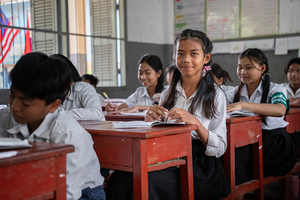
There is already a visible impact. Students gather excitedly each time the boats arrive, eager to pick up books, read with friends, and even borrow titles to take home. On each visit, 10 to 25 students join the floating libraries, discovering the joy of storytelling and expanding their imaginations.
The mobile libraries carry approximately 1,500 books spanning 180 titles, covering topics from fairy tales and science to history and everyday life skills. The project ensures that on average, 278 students per school gain access to these books each month, either by reading in the library or borrowing them for home reading.
“The improved access to books has been significant,” Samphors noted. “Students are reading more frequently, but their enthusiasm for learning is growing. The libraries are designed to spark curiosity and critical thinking – essential skills for their future.”
A 2023 survey by The Asia Foundation, involving 400 adults in Phnom Penh with children aged four to nine, revealed that 85% of parents read physical books with their children at least once a week. However, access to reading materials remains limited, with only 10% of households possessing more than 20 printed children’s books. Despite this, 100% of parents acknowledged the importance of reading to their children, though 84% cited a lack of time as a significant barrier.
Another 2016 survey by World Vision International found that 64.7% of children self-reported their reading proficiency as “Excellent,” “Very Excellent,” or “Good.” However, this self-assessment contrasts with national data indicating that only about 50% of children in grade 6 can read proficiently, suggesting a discrepancy between perceived and actual reading abilities.
This floating library initiative is part of a broader investment in education. With total educational funding in Cambodia reaching $57 million, the EAA Foundation alone has contributed nearly $25 million, partnering with Action Education, UNESCO, and United World Schools (UWS) to improve access to education nationwide.
In addition to providing books, the project addresses a critical challenge faced by children in floating villages: transportation. For 114 primary school students, the boats are not just mobile libraries but also a means of travelling to school safely, especially during the rainy season when water levels rise and travel becomes more dangerous.
Koh Chivaing and Prey Chas, like many communities on the Tonle Sap, struggle with economic instability due to climate change’s impact on fishing. Long boat journeys to school often discourage attendance, leading to lower academic performance. By bringing books directly to the children and assisting with school transportation, the initiative is tackling multiple barriers to education at once.
For young learners like 10-year-old Srey Neang, the floating libraries have been life-changing. “I love the stories about animals and adventure,” she said, clutching a borrowed book. “Before, I only had my school textbooks. Now, I can read many different books and learn new things.”
Her teacher, Sok Dara, has also seen remarkable changes. “Students who never used to read outside of class are now eagerly waiting for the library boats. It has built their confidence in learning and given them a sense of excitement about education.”
As the boats continue their journey across the Tonle Sap, they carry with them more than just books – they bring dreams, aspirations, and the promise of a brighter future. One visit at a time, they are proving that education knows no boundaries, not even on the vast, shifting waters of Cambodia’s great lake.
Jade McCulloch is director of engagement at Educate A Child programme of Education Above All Foundation.
Sopheak SREY is communication and partnership manager at Action Education in Cambodia.
Education Above All Foundation, with its partner Action Education, supports efforts to ensure displaced children have access to quality education.
Disclaimer: This article was first published on the Cambodianess News website and is reproduced here with permission. Click here to access the original post.