

Nop Sreymao / Khmer Times
In an initiative to narrow the digital divide across Cambodia, efforts have been made to introduce Information Communication Technology (ICT) education in schools, particularly in rural areas.
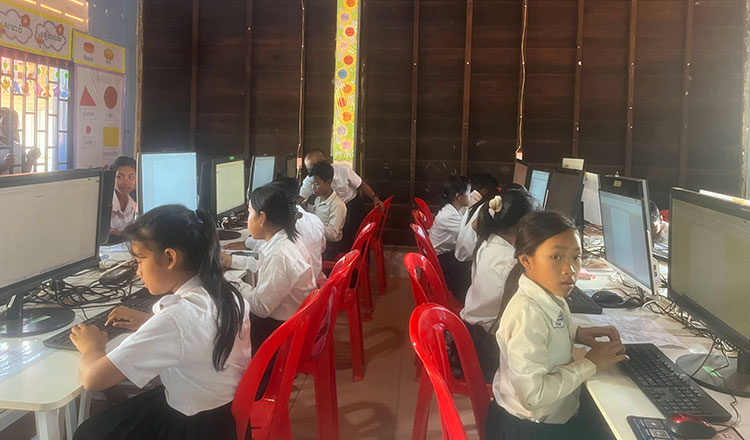
Students attend their ICT class at Khnar Primary School in Siem Reap province. KT/Nop Sreymao
Under the project led by Action Education in partnership with the Education Above All (EAA) Foundation’s Educate A Child Programme (EAC), four primary schools in Siem Reap province were equipped with computer labs in early 2025.
The newly launched computer labs in Khnar, Kampong Phluk, Prasat and Prey Chruk primary schools each have about 20 desktop computers.
The programme addresses education barriers, including poverty, conflict, gender discrimination, natural disasters, forced displacement and infrastructure.
Since 2014 EAA Foundation and its partners have been working in Cambodia, aiming to enroll 189,657 out of school children (OOSC).
As of Q4 2024, EAA Foundation’s projects have provided quality primary education to 144,590 OOSC through three interventions.
Additionally, 5,256 children at risk of dropping out received targeted support to remain in education.
Total investment in education initiatives in Cambodia amounts to $57,064,297, with EAA Foundation contributing $24,703,695 alongside partners Aide et Action (AEA), UNESCO, and United World Schools (UWS).
Kong Kimlin, the Khnar Primary school’s principal, said the aim of having computer labs in schools across all provinces in Cambodia aligns with the goal of the government, particularly the Ministry of Education, in advancing technology among students.
“We are pleased to receive this support, and I am committed to seeking further support from all the development partners to ensure that our students can have a fair education, especially in digital skills,” she said.
Tit Pheanith, an ICT teacher of Khnar primary school, highlighted the importance of introducing digital education to students in rural areas.
“It is quite important for students in rural schools to have digital access, and through my experiences of teaching them these past months, I recognise that the kids, regardless of their backgrounds, are interested in computers,” he noted.
“We select eligible students for the ICT class from Grade 4 to 6, in which each class comprises of at least 40 students,” he said. “But due to limited resources in terms of devices, we need to classify the students into two or three sessions for the ICT class, resulting in fewer hours for the students to learn.”
Pheanith added that it is essential that the students are equipped with technological education from the primary schools, as it will prepare them for higher levels of education in the future.
Established in 2012, the EAA serves as a global foundation with a mandate to advance education, development, and advocacy worldwide. EAA Foundation aims to transform lives through quality education and employment opportunities, recognising education as the most effective tool to reduce poverty, foster peaceful societies, unlock potential, and achieve the Sustainable Development Goals (SDGs).
Through multi-sectoral approaches, innovative financing models, and strategic partnerships, EAA Foundation brings hope and tangible opportunities to marginalised children and youth. To date, the Foundation has supported over 22 million children and youth in more than 60 countries through a network of 100+ partners, aligning with SDG 4 (Quality Education). EAA Foundation has also leveraged nearly $3 billion in co-funding through its partnerships.
In late 2024, the ministry announced the expansion of the Game Changers Coalition programme to 33 schools this year, aiming to empower girls with foundation technology education equipping them with technological skills in the digital age of the 21st century.
Around 100 exemplary teachers – one life skills teacher and one ICT teacher from each school – have been trained through a five-day intensive programme focussed on game development education. The training emphasised game development tools and the fundamentals of coding.
Jade McCulloch is director of engagement at Educate A Child programme of Education Above All Foundation.
Sopheak SREY is communication and partnership manager at Action Education in Cambodia.
Education Above All Foundation, with its partner Action Education, supports efforts to ensure displaced children have access to quality education.
Disclaimer: This article was first published on the Cambodianess News website and is reproduced here with permission. Click here to access the original post.